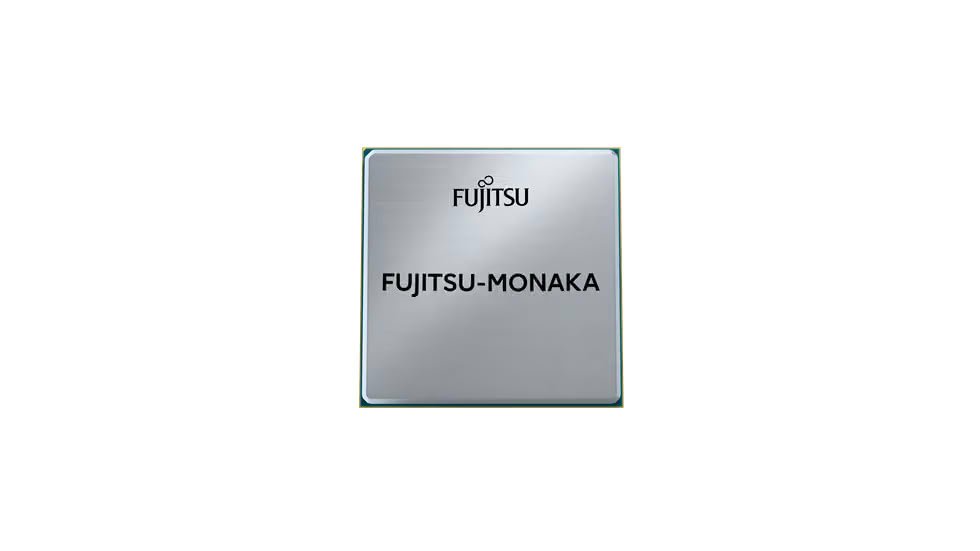
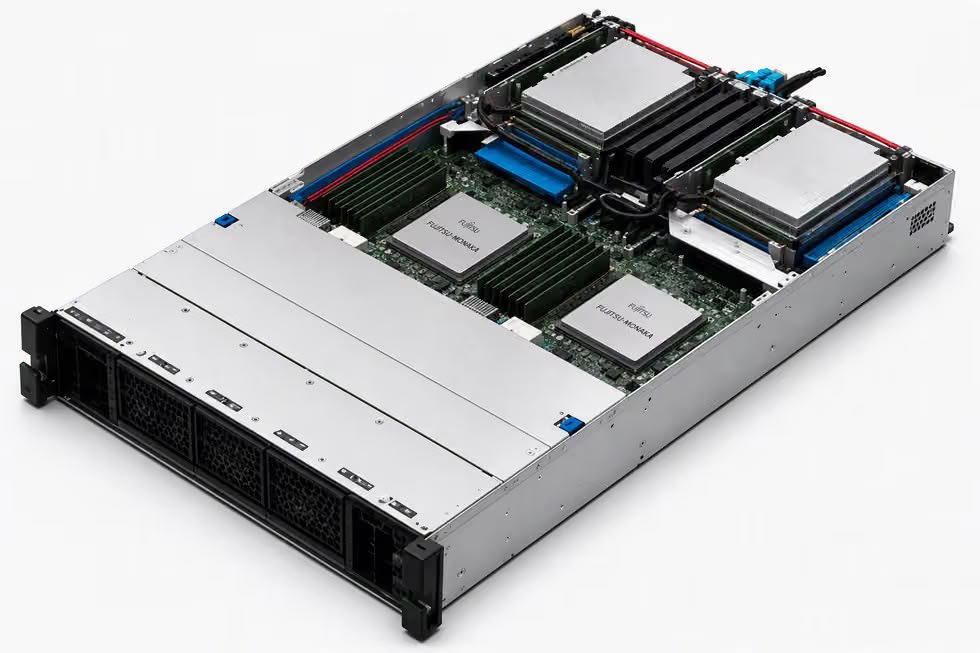
Fujitsu has announced that it will begin global sales of its next-generation processor, the FUJITSU-MONAKA, in November 2026. The company will sell the chip as a standalone product to cloud providers, data center operators, and server vendors. At the same time, it is launching the Fujitsu MONAKA Server, a made-in-Japan system built around the new CPU and aimed at sovereign AI infrastructure.
The servers will first be offered in Japan and Europe to data center operators, enterprises, academic and HPC users, and the defense sector.
Performance and Efficiency Claims
Fujitsu says the MONAKA CPU delivers strong computational performance and data throughput, with a maximum clock speed of 3.8 GHz and memory speeds of 8800 MT/s. The company claims the chip offers roughly twice the AI inference throughput of competing CPUs while using significantly less power — enough, in some cases, to cut the number of servers (and related power consumption) in half for the same workload.
The processor uses a 3D-stacked design that pairs a 2 nm process for the cores with a 5 nm process for the cache and I/O sections. Fujitsu’s ultra-low-voltage technology, combined with dedicated matrix-operation acceleration and SVE2 vector support, is intended to deliver practical AI inference performance from the CPU alone. The chip also includes confidential computing features that encrypt data and applications in memory for stronger security, including in multi-tenant environments.
Focus on Sovereignty and Practical Deployment
The MONAKA Server is designed, developed, and manufactured in Japan at Fujitsu’s Kasashima Plant. This domestic production is meant to improve supply-chain transparency and traceability — key requirements for customers concerned about geopolitical risk and data sovereignty.
Fujitsu will initially offer 1U and 2U rack-mount configurations suited to AI agents and inference workloads. The 1U models support CDI/CXL technology for resource pooling, allowing memory and accelerators to be shared more flexibly beyond a single server’s physical limits. The systems can run in air-cooled data centers at ambient temperatures up to 40°C (or with water cooling up to 45°C), which Fujitsu says can reduce cooling energy use by as much as 80%.
The company plans to position the servers as the foundation of a vertically integrated sovereign AI platform that also includes its Kozuchi AI software stack and Takane generative AI models.
Availability Timeline
- November 2026: Start of sales for both the standalone FUJITSU-MONAKA CPU and the first MONAKA Servers (Japan and Europe).
- Later expansions are planned for the US and APAC regions, along with higher-density and rack-scale systems in the future.
Fujitsu is pitching the platform as a way for organizations to run AI workloads more efficiently while keeping greater control over their data and supply chain.
Summary Chart
| Aspect | Details |
|---|---|
| CPU Name | FUJITSU-MONAKA |
| Server Name | Fujitsu MONAKA Server |
| Sales Start | November 2026 |
| Key Specs | Up to 3.8 GHz, 8800 MT/s memory |
| Claimed Advantage | ~2× AI inference throughput + higher power efficiency |
| Process Technology | 2 nm cores + 5 nm cache/I/O (3D-stacked) |
| Manufacturing | Designed and built in Japan (Kasashima Plant) |
| Target Markets | Japan & Europe first (cloud, enterprise, HPC, defense) |
| Cooling | Air-cooled up to 40°C ambient; reduced cooling power |
Sources: Official Fujitsu announcement.
What do you think of Fujitsu’s push into sovereign AI hardware with a home-grown CPU? Interesting alternative to the usual x86 and Arm options? I’d love to hear your thoughts!