Fujitsu has pulled back the curtain on its next-generation datacenter processor family at the Technology Update 2025 event, with the Arm-powered Monaka line set to challenge AMD and Intel in AI, HPC, and large-scale data processing.
The initial Monaka chip debuts in 2027 on a cutting-edge 2 nm process, emphasizing energy efficiency and scalability. Fujitsu aims for twice the power efficiency of current x86 rivals while sticking to air cooling — a bold move for high-core-count servers.
Core Specs: Monaka’s 2027 Debut
This first iteration packs a punch with a 3D chiplet design (core die + stacked SRAM and I/O dies) and Armv9-A architecture. It’s built for seamless integration into cloud, edge, and enterprise setups, drawing on Fujitsu’s supercomputing legacy from Fugaku.
| Feature | Details |
|---|---|
| Cores per Chip | 144 (Armv9-A cores) |
| Max Cores per Node | 288 (dual-socket) |
| Process Node | 2 nm |
| Memory Support | 12-channel DDR5 (MR-DIMM/MCR-DIMM compatible) |
| I/O Interfaces | PCIe 6.0 + CXL 3.0 |
| AI/HPC Extensions | Arm SVE2 (up to 2048-bit vectors) |
| Security | Arm Confidential Computing Architecture (CCA) |
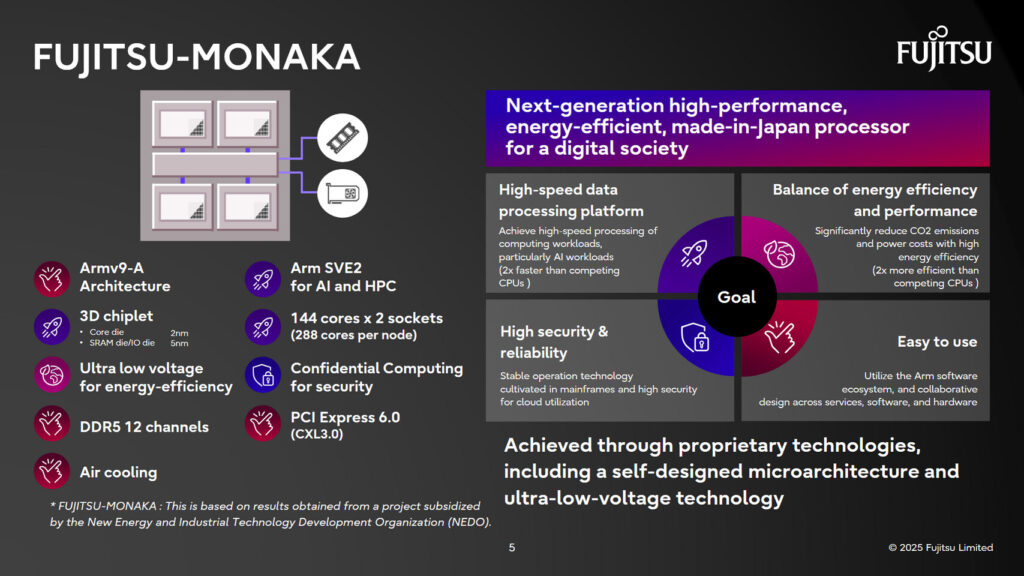
No HBM here — Fujitsu opts for massive L3 cache stacks and DDR5 for cost-effective capacity, targeting inference, simulations, and analytics workloads.
Developed with Broadcom’s 3.5D packaging tech, Monaka also gets firmware muscle from AMI for reliability and optimization.
The Full Roadmap: AI Acceleration Heats Up
Fujitsu isn’t stopping at basics. The lineup evolves with specialized variants, blending CPU power with integrated AI hardware:
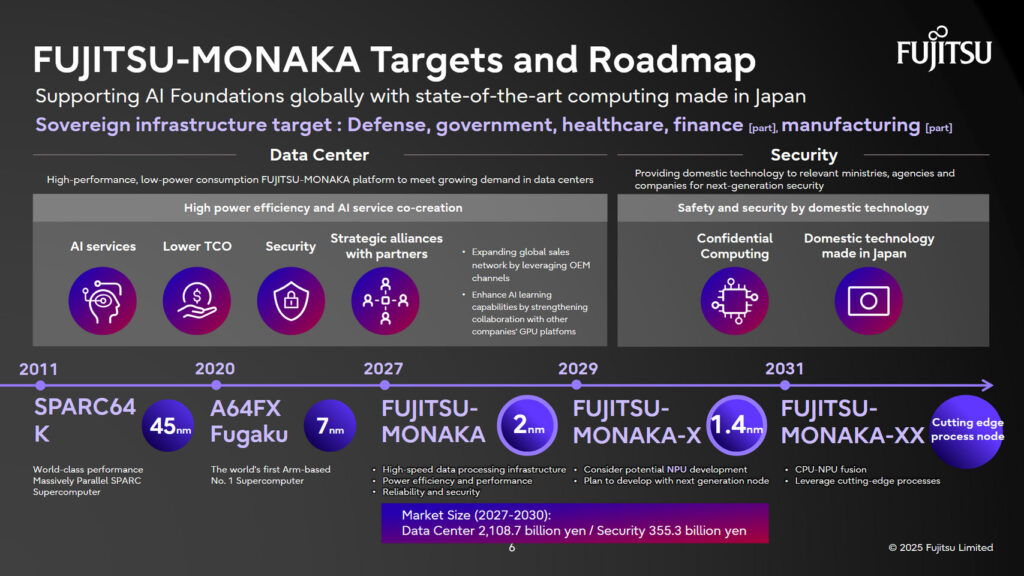
| Variant | Launch Window | Key Innovations | Process Node |
|---|---|---|---|
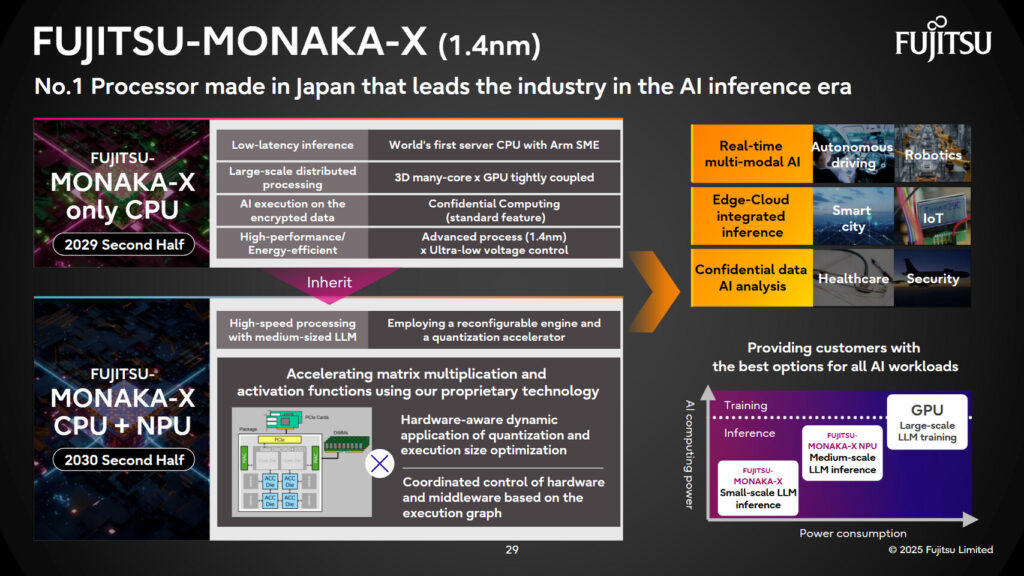
| Monaka-X | Late 2029 | CPU-only; first Arm SME (Scalable Matrix Extension); 3D many-core + tight GPU coupling; confidential computing standard | 1.4 nm |
| Monaka-X + NPU | H2 2030 | On-package NPU for mid-sized LLMs; reconfigurable engine + quantization accelerator | 1.4 nm |
| Monaka-XX | 2031 | Full CPU-NPU fusion; ultimate AI/HPC integration | 1.4 nm+ |
These steps push Fujitsu deeper into Arm’s ecosystem, with community efforts on tools like LLVM, Python, and Fortran for optimized performance. The goal? Scalable, green datacenters that handle exploding AI data without guzzling power.
Why It Matters
Monaka positions Fujitsu as a quiet contender in the Arm server wars, leveraging its HPC roots for broad adoption in telco edges, cloud providers, and AI factories. With partners like Arm and Supermicro, expect ecosystem demos at Supercomputing 2025.
If you’re in datacenter planning, mark 2027 — this could redefine efficiency for Arm-based servers.
Source: Fujitsu